

Slowing Down AI Is a Subsidy for Scammers
Every few weeks someone proposes we all, collectively, slow down AI. For safety. Here's why that toast keeps getting raised in the wrong direction — and why we built Argus, the guard who never blinks, to point capability at the liars instead of away from them.
Jeffrey Phillips Freeman
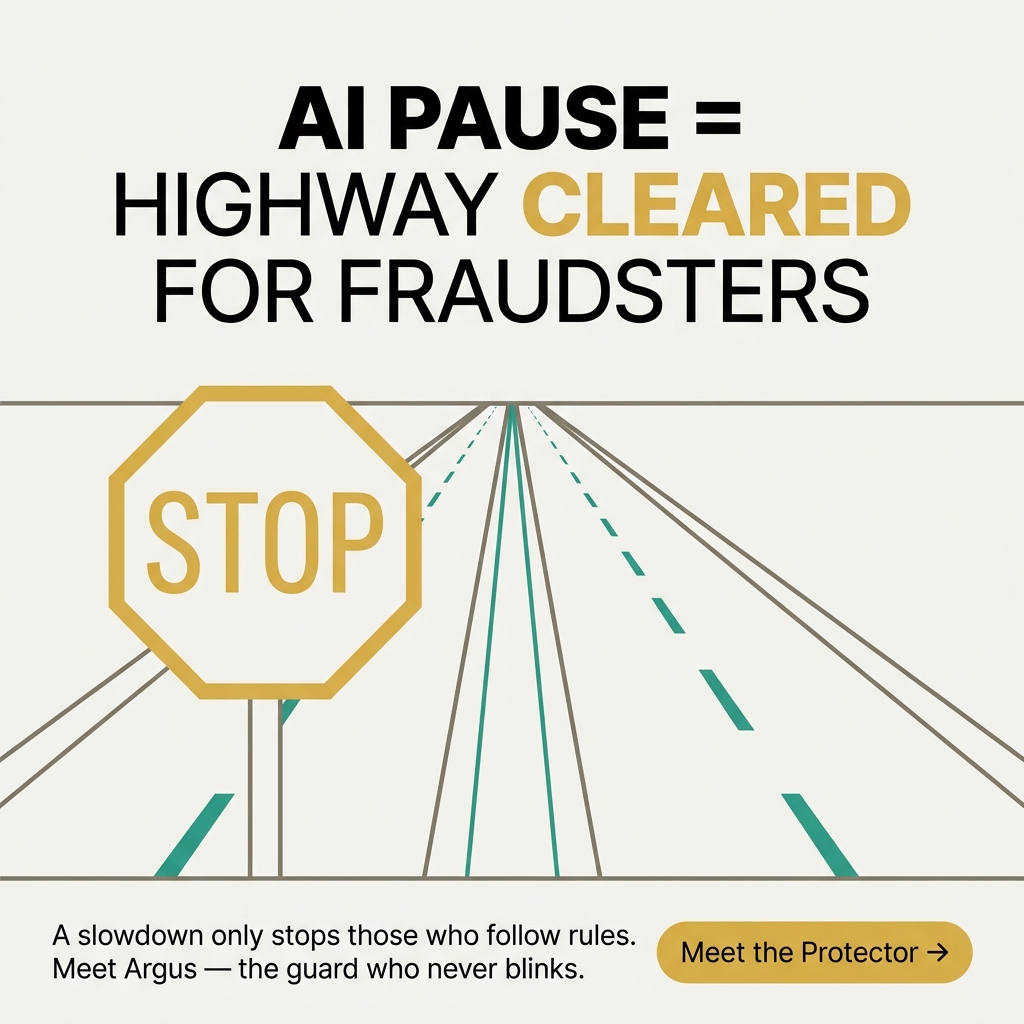 A pause is a speed limit only the law-abiding drivers can see.
Every few weeks, someone with an extremely serious jawline stands at a lectern and proposes that we all, collectively, slow down AI. For safety. There is usually a tasteful sans-serif slide behind them.
And every time, somewhere, a man renting a GPU by the hour to clone your daughter's voice quietly raises a glass. To safety.
I want to talk about why that toast keeps happening — and I say this as someone who once lost an entire weekend to a bug that turned out to be a single inverted boolean, so please, calibrate your trust in me accordingly.
A pause is a gentlemen’s agreement, and the problem is not a gentleman
Here is the whole argument against the slowdown, and it fits on an index card:
A pause only pauses the people who agree to be paused.
The lab that signs the pledge stops. The research group that testifies before the committee stops. And the fraud ring operating out of three rotating jurisdictions does not stop, because the fraud ring did not attend the hearing, does not read the open letters, and has never once been described as “a responsible stakeholder.”
It's a speed limit that only the law-abiding drivers can see. Which doesn't slow the getaway car down. It just clears the highway for it and turns off the streetlights on the way out.
I keep circling back to this because I've been shipping systems for a couple of decades, and the beautiful, elegant safeguard fails the same way every single time: it quietly assumed everyone was playing the same game by the same rules. The lock is exquisite. The attacker came through the window. The rules bound only the people who were never the threat, and the threat sent a thank-you note.
Capability is not the villain here
The slowdown crowd has smuggled in an assumption, and I'd like to confiscate it at customs: the idea that capability itself is the danger. That the raw horsepower of the model is the thing to fear.
It isn't. A very powerful engine bolted to nothing is not dangerous, it's just loud. Capability pointed at nothing is a paperweight with excellent benchmarks.
The danger is capability aimed — at the forged invoice, the cloned voice on a bad phone connection, the deepfaked “URGENT wire request from the CEO, I’m boarding a flight, handle it” email that has ended more careers than any recession.
“The only thing that reliably stops powerful AI in the wrong hands is more powerful AI in the right ones, pointed directly at the abuse.”
You do not answer an armed attacker by disarming the guard. You have simply, at great expense, invented a softer target.
What a real defender actually has to do
It’s easy to say “AI defends you” and hand-wave. The devil, as always, is in the part everyone skips. A defender that earns the name has to do three genuinely hard things.
A defender that earns the name has to:
- Inspect what reaches you at the moment of contact — before you act on it. Not a weekly report, not a dashboard you’ll check on Thursday. The scam works in the ninety seconds between the ping and the panic. The defense has to live in those ninety seconds or it’s just very well-formatted hindsight.
- Catch the manipulation a spam filter sleeps straight through. Your spam filter checks whether an email is annoying. It has no opinion on whether it’s lying. Those are different questions, and only one of them empties your bank account.
- Show its work. Every judgment traceable to a source. Every “this is a forgery” backed by why, not vibes — because a protector that says “trust me, I’ve got a feeling about this one” is not a guardian, it’s just a second attacker with better manners.
That third pillar is, not coincidentally, the thing this company has been quietly obsessed with since before it was fashionable: AI that cites itself, grounds every claim in evidence, and refuses to hallucinate its way to an answer you can’t check. Turns out the muscle you build teaching a model to never make things up is exactly the muscle you need to teach it to catch someone else making things up.
So we built the guard. He has a hundred eyes and he does not blink.
At CleverThis, this stopped being a thesis and became a product. We built a protector agent that does exactly these three things — it screens what’s coming at you, flags the manipulation the filters miss, and hands you an auditable trail for every single call it makes. It runs on GISM-0, and it is very much live and very much watching.
We named him Argus.
If you skipped that particular myth: Argus Panoptes was the hundred-eyed giant of Greek legend, the watchman who never fully slept because some of those eyes were always open. It was, frankly, the most on-the-nose name we could find, and after weeks of committee-grade deliberation we decided that being on-the-nose was, in this specific case, the entire point. Subtlety is for products that don’t work.
The grandiose framing: a sentinel standing in the gap between you and the machine-generated deceptions of a suddenly very strange age. The honest framing: a deeply paranoid, extremely fast agent that assumes every incoming message might be lying to you and makes it prove otherwise before you’re allowed to care about it. It’s Gandalf on the bridge — except the Balrog is a phishing email wearing your bank’s logo, and Gandalf pauses mid-“you shall not pass” to cite his sources.
100
Eyes On Your Inboxnone of them blink0
Scammers Who Signed The Pausewe checked90 sec
Between The Ping And The Panicwhere Argus livesThe part nobody in the “just pause it” camp can answer
Disarming the defenders has never once, in the entire history of anything, handicapped the attackers. Not for locks, not for encryption, not for vaccines, not for firewalls. Every time we’ve made the world safer, we did it by arming the good guys better — not by politely asking the bad guys to hold still.
The pause was always a comforting story we told the people who were never going to break the rules anyway. Argus is the other approach: don’t slow the machine down, aim it at the liars.
Come see what verified-before-you-act actually looks like when it’s running, not theorizing — the CleverThis Protector Agent, live on GISM-0. Spin up your own instance from the dashboard.
And if you still think a global pause is the answer, I’d genuinely love to hear the implementation plan. Specifically the part where you get the scammers to sign it. I’ll wait. Argus won’t — he’s already reading your inbox, and unlike the rest of us, he never needs the weekend.


CleverThis is a sustainable AI gateway with hosted Actor endpoints — by the team behind CleverThis.
Join the newsletter
Product updates and engineering notes. No spam, ever.