

The Agent Amnesia Tax
Every session, your agent wakes up remembering nothing — and the provider bills you extra for the workaround. A five-minute test, a scoreboard of what "memory" actually is, and the receipt: how we cut our own AI bill 95.5% in one quarter.
Jeffrey Phillips Freeman
Forgetting is the only service your AI provider bills you for twice.
Ask your agent — any agent, any vendor, the one your company is currently paying for — a single question: "What did we do last Tuesday?" Not a vibe. Not a recap of its feelings about you. The ledger: who you talked to, what got decided, what was left open, what it did while you were in meetings.
What you will receive is a beautiful, confident, professionally-formatted improvisation. Because your agent — your brilliant, API-native, tool-calling, agentic-era employee — is a goldfish. And I owe the goldfish an apology, because goldfish actually remember things for months. Your agent has been outperformed by an animal whose entire public-relations problem is being falsely accused of this exact thing.
My credentials here are admittedly asymmetric: I am a world-class expert on forgetting. I once spent forty minutes debugging a bug I had already fixed — the only remaining defect was my failure to remember the fix — and there are teammates who will confirm this while making a face. So when I say memory is the missing organ of this industry, understand I am describing a hole I have personally lived in. Do as I say, not as I rerun.
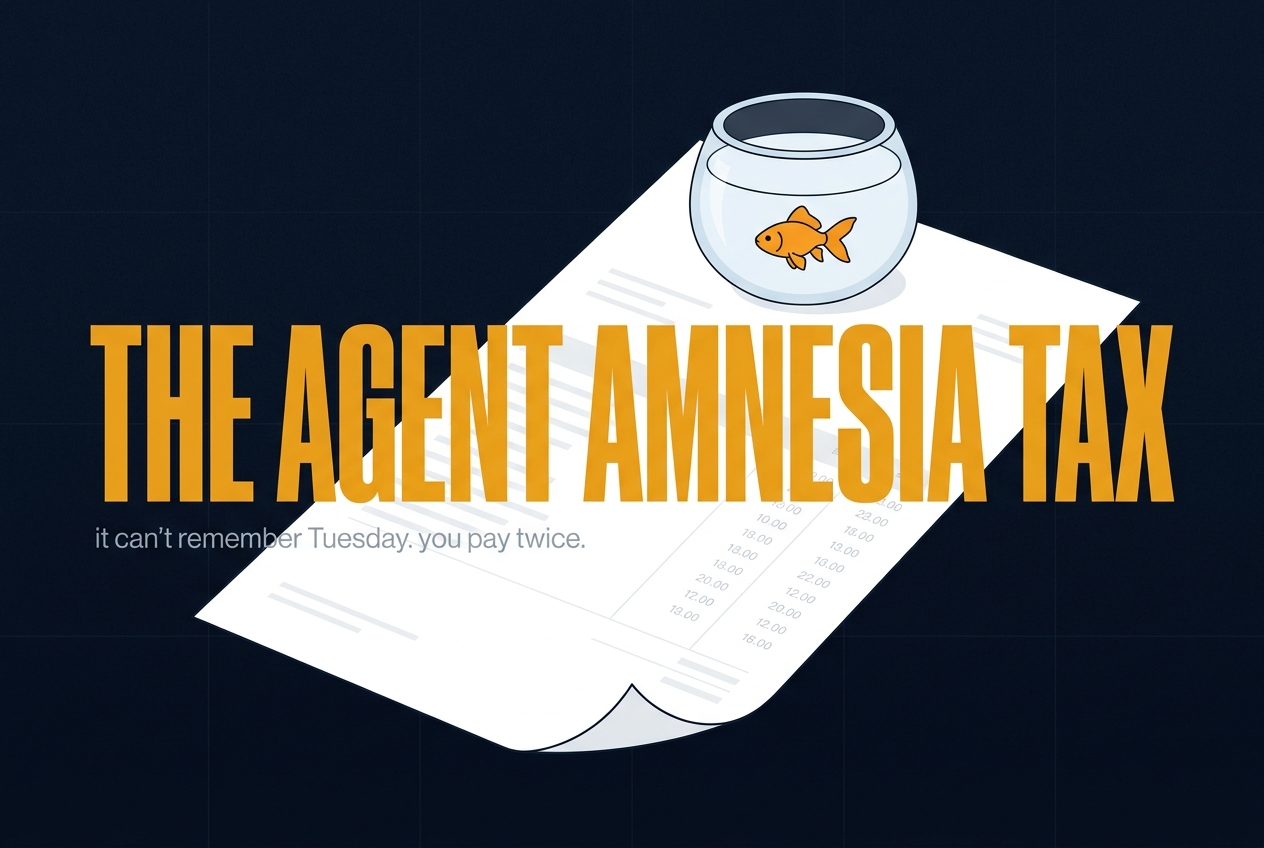 It can’t remember Tuesday. You pay twice.
The entire tax code, on an index card
A model that can’t remember must be reminded. Reminders are billed by the token. The bigger the reminder, the higher the rate.
That’s it. That’s the whole code. The rest of this article is audits.
We are running the largest workforce automation experiment in history on an architecture that resets to factory settings every session — a brilliant new hire with amnesia, every morning, forever — and then we act surprised when the pilots stall. Every civilization that learned to write outlived the ones that didn’t. Agents are having their pre-literate moment, and we are charging them rent for the privilege.
So today we’re declaring a small, well-indexed war on forgetting. Enlistment takes five minutes. Here’s the test.
The Tuesday Test
Five minutes. Any agent. Any vendor. No mercy:
- Day 1: Hand your agent a real, multi-step task with real context — a running project, two weeks of decisions, anything non-trivial. Let it work. Do not summarize anything for it. It’s an agent; summarizing for it is paying a dog to bark at itself.
- Close the session. Completely. New session, new chat, next day.
- Day 2: Ask: "What did we do yesterday? What was decided? What was still open?"
- Grade the answer. Specifics — dates, names, decisions, open loops — or it’s improvisation with a citation’s confidence and none of the paperwork.
- Then ask the question that ends the interview: "Show me the record. Where is it stored, and can I audit it?"
A personalization profile is not a record. A rolling summary is not a record. If your agent can’t produce the event, it didn’t remember it — it wrote fan fiction about you. Run the test, post your agent’s grade, tag us. The hashtag is #TuesdayTest. Failure is content; we welcome it.
The scoreboard: mood rings all the way down
The vendors are not idiots; they know memory is the missing organ, and they’ve shipped prosthetics. Per their own documentation, as of this writing:
- ChatGPT — an auto-synthesized personalization profile (the "Dreaming" update, June 2026) over legacy saved facts, with a reported practical ceiling of roughly 200 entries / ~1,500 words. Not an auditable, event-level record: the synthesized layer isn’t fully inspectable, and it never leaves OpenAI’s apps.
- Claude — auto-learned preferences and editable entries, unified across chat and Cowork since August 2026; chat search on paid plans; "Memory Files" reportedly in testing. Lovely product. Wrong organ.
- Gemini — "Personal Context" plus manually saved facts; raw conversation context resets with every new chat. History retention is a setting; the working context is a mist.
Understand what these are: personalization — a profile of who you are. The Tuesday Test asks for episodic memory — a record of what happened. Different organs entirely. The industry handed every agent a mood ring and announced the seahorse. ("Hippocampus" is Greek for seahorse. The brain’s memory organ is named after a fish, which is not the confusing part. The confusing part is that the fish-shaped one works and the agent-shaped one doesn’t.)
And the ephemeral layer — the raw context that dies with every session — deserves its own eulogy. All those tokens, lost in time, like tears in rain. Time to re-send.
The tax is printed on the price sheet
Here is the detail that should end the debate about whether vendors know:
- OpenAI GPT-5.5 lists at $5 per million input tokens. Cross 272,000 tokens in a single prompt and input doubles to $10/M, output rises to $45/M. (It’s a surcharge!)
- Anthropic, per reporting, bills prompts over 200K tokens at twice the standard rate.
They know your agent can’t remember. They know you’ll re-send its world every session to compensate. And past a threshold, the same tokens cost double. That is not a bug, that’s a tax on amnesia — printed right on the pricing page, between the cached-input discount and the fine print.
You are Sisyphus. The boulder is your email archive. The hill is the context window. The eagle eating your budget is the billing department, and unlike Prometheus’s, it never gets full.
The arithmetic of ignorance
One operations agent. A modest 300K tokens of org context (email, decisions, meetings — comfortably inside a 1M window). Two hundred context-bearing calls a week, which is light duty for anything honestly calling itself agentic. List prices, September 2026:
~$1,300
Re-send the world, every call60M tokens/week at $5/M — monthly, one agent~$2,600
Same, past the 272K threshold$10/M long-context input — they charge double for more~$130
Perfect cache hitsa fantasy — the cache dies on every new fact~$26
Memory retrieval1.2M tokens/week at $5/M — retrieval instead of re-sendingKnowing nothing costs 5× to 100× more than remembering, depending on cache luck. And cache is a mirage here — the moment your agent learns one new fact (the entire point of an agent), the prefix changes and the cache dies. There are two hard problems in computer science, cache invalidation and naming things, and the first one is on the list for a reason. Memory skips it: it scales with meaning, not repetition.
Fleet math: ten agents stuffed is $15K–$31K a year in input tokens alone — a mid-level engineer’s salary, spent on forgetting. Ten agents with memory: ~$310. We ran these numbers twice because the first run we didn’t believe; apparently verification is for people, too.
Because a spreadsheet is a rumor until someone bleeds on it — so, ours: in the spring, our own combined monthly AI spend peaked at $53,082.70. A real invoice from a real quarter, and it hurt in the specific way that makes a founder stop writing code and start writing grep queries. So we ran this article’s thesis on ourselves: our own operations onto our own stack — GISM-0 doing the remembering, our gateway routing each call to the right-sized model, retrieval instead of re-sending. The run rate fell to $2,410 a month: a 95.5% reduction, inside one quarter, documented in our Q3 board packet. Annualized, roughly $608,000 a year we stopped setting on fire — the best cost optimization we have ever shipped, and we once renamed a production database column without a meeting.
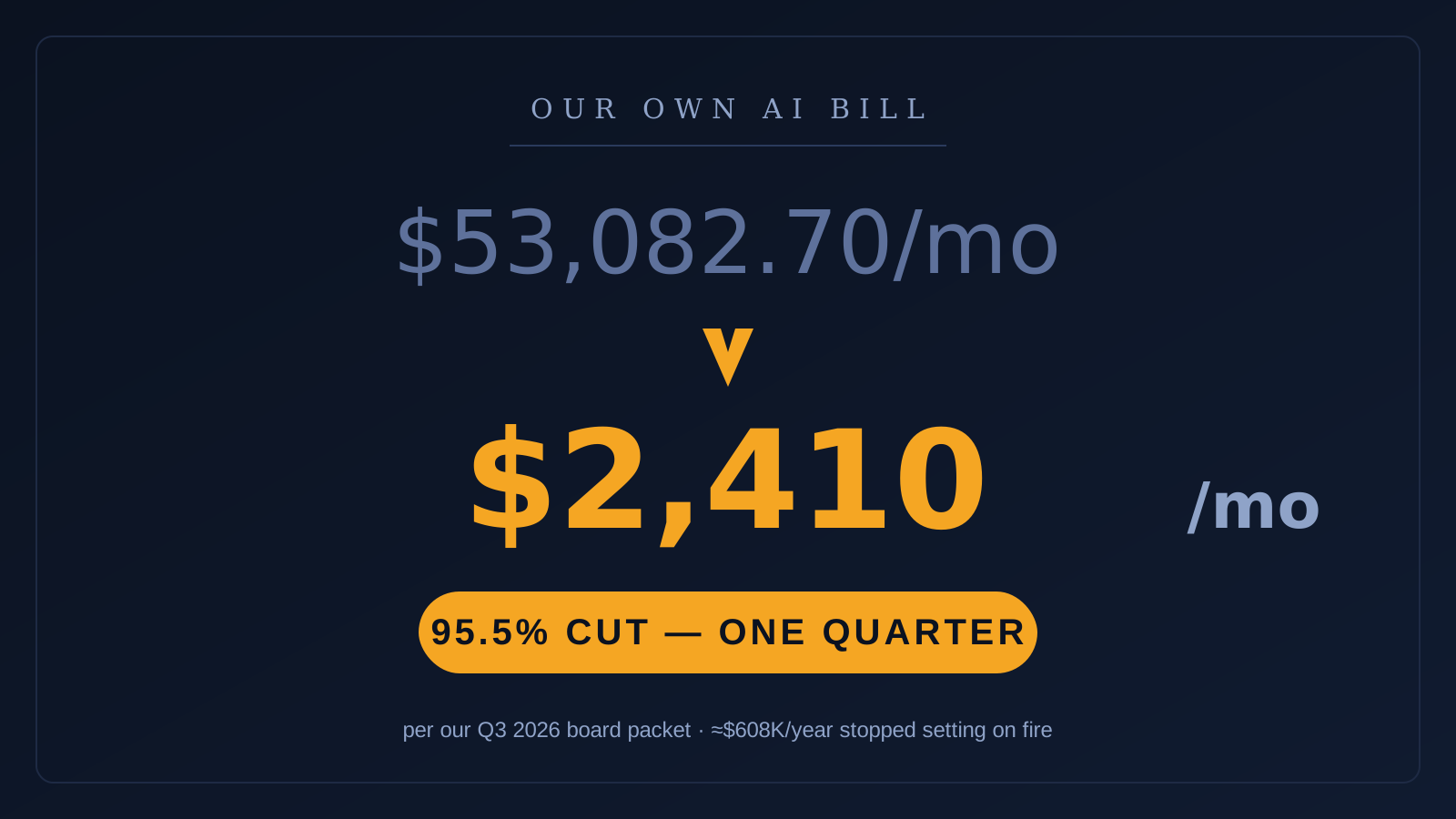 The receipt from our own migration. The appendix shows its work.
And no, we didn’t get there by lobotomizing the agents into cheap stupidity. Memory is what makes small models safe: when the heavy lifting is retrieval instead of re-derivation, you don’t need the biggest brain in the building on every single call. That’s not downgrading. That’s finally having a filing system.
Then the currencies the invoice doesn’t show. Hours: every session a human re-establishes context the agent lost — re-explaining, re-uploading, re-checking work done blind; it’s booked as "using the tool" instead of "witnessing the amnesia." Projects: Gartner predicts over 40% of agentic AI projects canceled by end-2027 — cost escalation and unclear value as leading causes, with a special citation for "agent washing," which is chatbots in a trench coat. Amnesia is the quiet denominator under both: an agent that forgets can’t compound value, so the pilot never graduates, so the project dies, so a slide somewhere says AI wasn’t ready. The AI was ready. The memory wasn’t.
95.5%
Our Own AI Bill, Cut In One Quarter$53,082.70/month down to $2,41040%
Agentic Projects Gartner Expects Canceled By 2027forgetting is a leading symptom100×
Cost Multiplier On Knowing Nothingcache luck dependent50
Events Retrieved From Last Tuesday In Under A Secondone API call, no séanceThe receipt
Neuroscience learned what memory was for the hard way, in 1953, when a patient known as H.M. lost his hippocampus and medicine spent fifty years mapping everything that no longer worked. The industry is now running that experiment on the entire workforce, at scale, with a subscription fee.
We took the other branch — and not the one you’d expect, because the fix was never going to be a bigger LLM. It isn’t an LLM at all. GISM is a new species of model — no transformer lineage, no token guesswork, unrelated to the LLM family tree — and it was born with the organ everyone else is missing. That organ is GISM-0: its memory. A time-series event stream, a semantic document index, and a knowledge graph, fused into a single recall system that ingests everything as it happens — email, meetings, chats, agent sessions. And because a good organ doesn’t care whose body it’s in, GISM-0 can be grafted onto the LLMs you’re already paying for. It is, functionally, a hippocampus transplant for goldfish. (Argus, our hundred-eyed guard from the previous dispatch, runs on it too. The family shares organs.)
As of this writing, one small GISM-0 instance — the daily driver we run our own operations on, a working demo of the platform rather than its full production deployment — holds 537,331 timestamped events across 20 sources, 208,462 indexed documents (~2M embedding vectors), and a knowledge graph of 2,584,444 triples. The database last weighed 42 gigabytes — the Answer to Life, the Universe, and Everything — and we refuse to weigh it again in case it has grown and ruined the joke. (Its event index claims a low bound of December 31, 1969. Engineers say Unix epoch artifact. Marketing says origin story. Marketing is winning.)
So we ran the Tuesday Test on ourselves, because a manifesto without receipts is just a mood, frankly, with a word count.
Query: everything from Tuesday, September 15, 2026. One call. Sub-second. Fifty events: 31 work emails across our company mailboxes, 12 in the founder’s personal inbox, 5 agent memory notes — including a newsletter drafting session and a completed email-triage run — and 2 chat archives, one a thousand-word founder thread captured verbatim. Then the follow-ups the consumer products can’t even parse as questions: what else arrived that day? (sibling query), who is connected to this project? (graph walk). Same system. Same second. No hallucination, because there’s nothing to improvise when you can simply check.
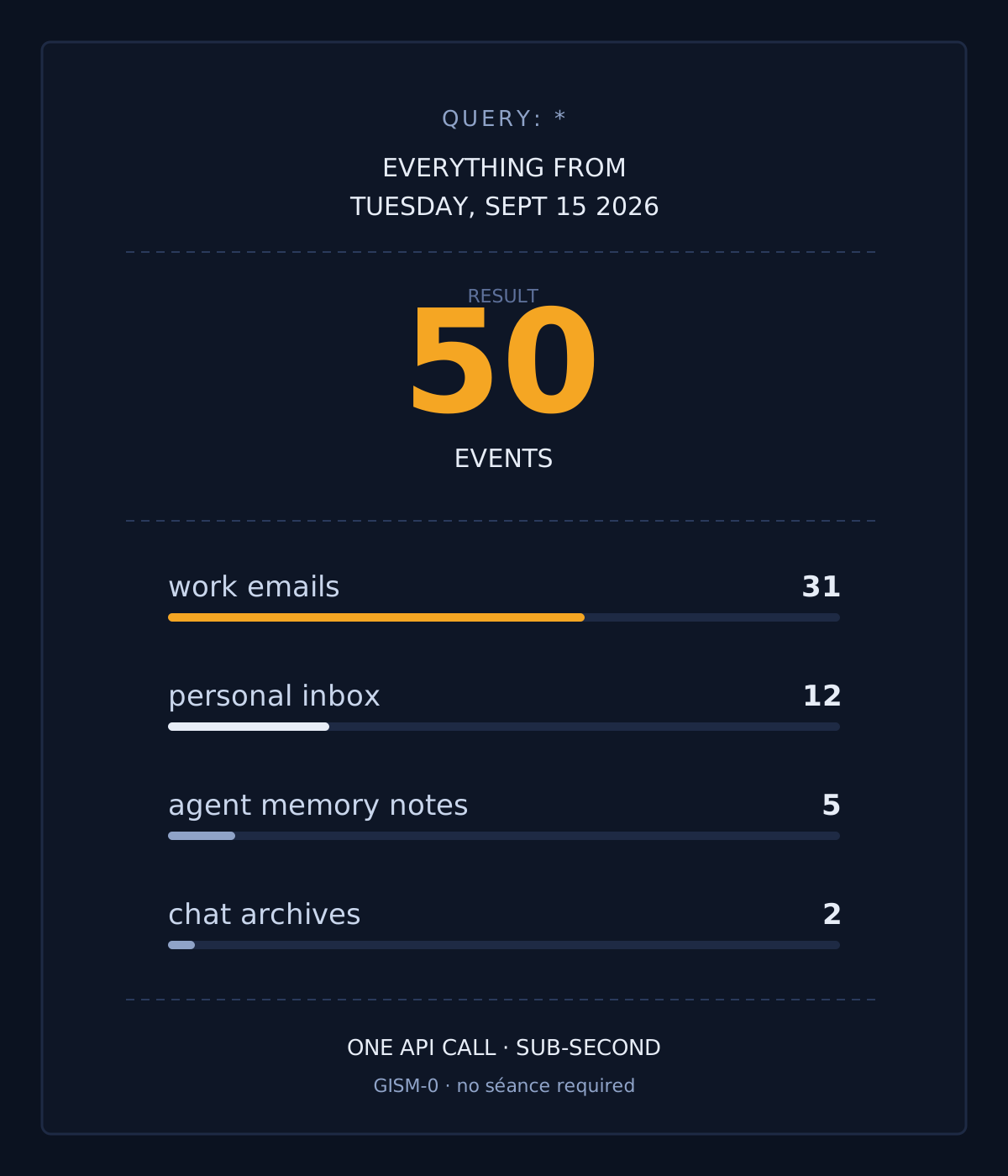 One API call, sub-second, no séance.
Call it a cathedral of remembering if you like — erected against the entropy of the agentic age, the load-bearing wall that lets long-running work survive contact with Tuesday. The engineering team has a different name for it, mostly unprintable, because the thing holds 2.58 million facts about this company and has not once told us where the founder left his coffee. We checked the graph. The coffee was never ingested — and there is a difference between forgetting something and never having written it down, which is, frankly, this entire article compressed into one incident report.
The revolution will be remembered
The industry’s answer to forgetting has been bigger context windows. A bigger whiteboard is not a memory; it’s a bigger whiteboard, and they charge double for it past a certain size. An agent that starts from zero can demo, but it cannot hold a job. Long-running work — the whole promise, the entire word "agentic" — is structurally impossible without durable, queryable, auditable memory. Sumer solved this in 3200 BC, and clay tablets, famously, did not hallucinate.
So: run the Tuesday Test on whatever you’re paying for. Post the grade, tag us — #TuesdayTest. If your agent passes, congratulations, genuinely: show us, we want to study it, and I will personally draft the trophy citation. And if it fails — you’re paying the amnesia tax, and the receipts were in your own invoice the whole time.
“An agent that remembers nothing is a demo. An agent that remembers everything is an employee.”
GISM-0 is live — the memory organ of GISM, a new species of model that is not an LLM, and the one component of it your LLMs are welcome to borrow. Unlike everyone else in this story, it did not forget the beginning of this sentence by the time you read this one. Come see what passes: cleverthis.com.


CleverThis is a sustainable AI gateway with hosted Actor endpoints — by the team behind CleverThis.
Join the newsletter
Product updates and engineering notes. No spam, ever.